- Decimal Odds
- Hong Kong Odds
- Indonesian Odds
- American Odds
- Malay Odds
 English
- English
 Vietnam
 Thailand



-
1
 Qwerty BFollow84.2%Win Rate +76.4%ROI 19Tips 2.15Avg Odds
 -
2
 Kobe 24Follow78.6%Win Rate +43%ROI 14Tips 1.90Avg Odds
 -
3
 AbuleWon 7/8Follow76.5%Win Rate +21.8%ROI 17Tips 1.60Avg Odds
 -
4
 ConstanceWon 6/7Follow71.4%Win Rate +14.2%ROI 21Tips 1.56Avg Odds
 -
5
 FezzyyWon 3/4Follow70.6%Win Rate +26.8%ROI 19Tips 1.83Avg Odds
 -
6
 SilleyspFollow69.4%Win Rate +30.6%ROI 51Tips 1.86Avg Odds

The Premier League has become a psychological battleground
The Guardian has dissected how the Premier League run-in this season has evolved into an extreme psychological battle. The title race and relegation fight are now heavily shaped by mentality and media pressure. Among them, the three London clubs—Arsenal, Tottenham, and West Ham—are bearing the greatest burden, while Manchester City, having dropped points earlier, now approach the finale with the relative freedom of a chaser.
Modern football has achieved remarkable precision in managing players’ physical condition and tactical execution, yet it still lacks a mature, structured system for psychological support. Players and managers are left to cope with pressure in their own ways, leading to inconsistent approaches. Meanwhile, the overwhelming noise of online discourse only amplifies anxiety. Coaches such as Mikel Arteta, Pep Guardiola, and Nuno Espírito Santo all demonstrate vastly different styles of mental management, highlighting the urgent need for a systematic psychological framework in football.
In his recent book “Fallen Giant” (translated as “Redemption”), Gianluigi Buffon revealed that even at the peak of his career, he was often suffocated by intense pressure. On the eve of the 2006 World Cup final, Buffon and Gennaro Gattuso encountered the French squad after training. The sheer physical presence of their opponents immediately unsettled the Italian team.
“We’ve got no chance,” Gattuso joked—but there was truth behind it. That night, Buffon and half the squad stood smoking in the hotel corridor, unable to sleep. At breakfast the next morning, silence dominated. By the time they arrived at the stadium, they were already mentally drained.
Fortunately, Buffon found his own way to cope. Before kickoff, he sat alone in the dressing room, completely undressed, quietly “speaking” to his goalkeeper gloves.
“I talk to my gloves. They’ve been with me throughout my career, and I feel they give something back—almost like they carry energy. I’ve always believed that objects hold a kind of spirit that can influence a match.”
With his mindset restored, Buffon delivered a series of crucial saves, and Italy went on to win the World Cup on penalties, securing their fourth title.
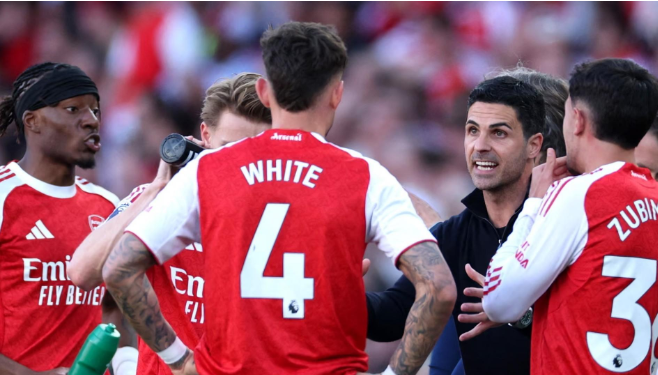
Reading this story inevitably brings to mind Arteta—perhaps he, too, should “talk” to his iconic long coat, or sit quietly in his signature black merino turtleneck. One wonders what kind of emotional weight is embedded in those grass-stained, sweat-soaked grey trousers he wears on the touchline.
With four weeks remaining, what once seemed like a dull Premier League season has transformed into a gripping finale—and, more importantly, a large-scale psychological contest.
The outcome of both the title race and relegation battle will largely depend on whether Arsenal, Tottenham, and West Ham can withstand immense pressure.
This situation is unprecedented. While intense run-ins are not uncommon, rarely have results been so closely tied to mental collapse and psychological fragility.
The pitch has become a psychological battleground: Arsenal fans appear pale and anxious; players show visible signs of strain; and Arteta himself has been caught in visible self-doubt after dropped points at Selhurst Park.
Two key points emerge from this mental battle. First, the outcome is highly contingent. Had Brentford’s Yoane Wissa been more clinical with a late chance at the Emirates, Arsenal might have suffered a devastating psychological setback.

Manchester City, by contrast, “wisely” dropped points earlier in the season rather than during this critical stage, allowing them to move forward calmly as challengers. Guardiola appears relaxed, even carefree in demeanor, while players like Rayan Cherki seem to be enjoying their football. Even if City fall short by a single point, their resilience would still be admirable.
Similarly, teams like Wolves and Burnley, having fallen behind early, are spared the mental burden of a high-pressure finale.
More importantly, football still lacks a mature system for managing psychological stress.
Every aspect of the modern game is meticulously analyzed—from nutrition to tactical data—but mental conditioning remains fragmented and unstructured.
After a match against Newcastle, Declan Rice dismissed external pressure as mere noise that should be blocked out. In contrast, Callum Wilson, after scoring a decisive goal against Everton, embraced pressure as motivation, emphasizing the importance of fans as the team’s “12th man.”
These contrasting perspectives reflect a broader reality: in the face of psychological challenges, everyone is left to find their own solutions.
Historically, football has relied on unconventional methods to deal with pressure. Brian Clough once had players train inside goal nets or run through stinging nettles to toughen their mentality. José Mourinho often diverted pressure by creating off-field narratives. Gareth Southgate meticulously deconstructed penalty shootouts through sports psychology. Sir Matt Busby adopted a compassionate management style to stabilize his squad, in contrast to the anxiety-driven approach of Liverpool’s George Kay.
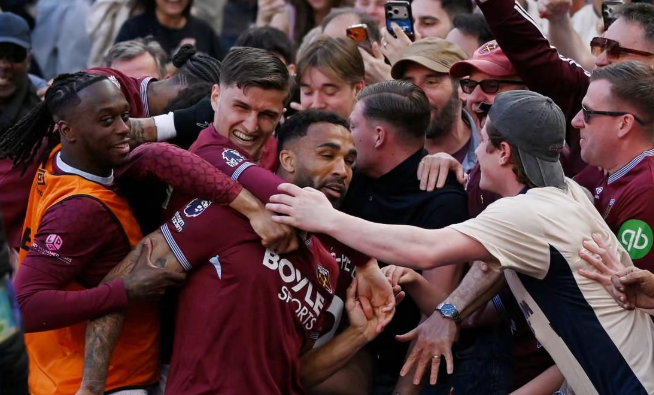
In recent years, however, the nature of pressure has fundamentally changed. Never before in human history have individuals been subjected to the constant scrutiny of billions. Around-the-clock media coverage, online groupthink, and relentless public discourse have become unavoidable sources of mental strain.
Modern football is now deeply entangled in online banter, polarization, and provocation. Potentially becoming a key area for future academic study. Professional sport has yet to fully confront this issue.
Even a detail-oriented coach like Arteta relies on fragmented methods to manage team morale, often trying to artificially create a relaxed atmosphere. But such efforts can feel forced—and may become a hidden vulnerability in Arsenal’s title challenge.
Guardiola, backed by experience and squad depth, operates with composure; Roberto De Zerbi, now at Tottenham, adopts an empathetic, brotherly approach; Nuno Espírito Santo at West Ham has shifted from bluntly addressing anxiety to fostering encouragement and collective spirit.
The core issue remains: football lacks a standardized psychological support system. Despite its high level of professionalism and scientific development, the sport still depends heavily on individual coaching philosophies when it comes to handling pressure.
Human nature is complex, players differ in personality, and team dynamics are constantly evolving—this unpredictability is part of football’s unique charm. Yet building a structured psychological support framework may well be the next major step in the sport’s evolution.
The remaining fixtures will continue to test mental resilience. Manchester City’s next league match is scheduled for May 4. If Arsenal defeat Fulham this weekend, they could extend their lead to six points—but Fulham have taken points in three of their last five meetings, making them a dangerous opponent.
Given Arteta’s current all-in approach, Arsenal might actually benefit from adopting a challenger’s mindset.
On May 10, West Ham will host Arsenal in what promises to be one of the most psychologically intense London derbies in recent years.
Regardless of external noise, Arteta’s commitment to his tactical framework and refusal to be distracted appears to be the right approach.
Some believe Arsenal will eventually experience a psychological release—breaking free from accumulated pressure to play with freedom and fearlessness.
However, their tightly structured system may itself serve as a form of psychological support.
This season, Arsenal have built their campaign on consistency and incremental gains. Their rhythm and performance rely on delicate balance—disrupting that mental equilibrium could prove more harmful than beneficial.
 Telegram
 Facebook
 X
X